Google tests model routing to reduce AI agent task costs
November 4, 2026
Read Original: Google Developers BlogGoogle Developers Blog has published an experiment exploring whether a lightweight classifier can reduce the cost of coding-agent work by selecting an appropriate model configuration for each task. The November 3 article argues that teams should measure spending against successfully completed tasks, rather than comparing token prices alone.
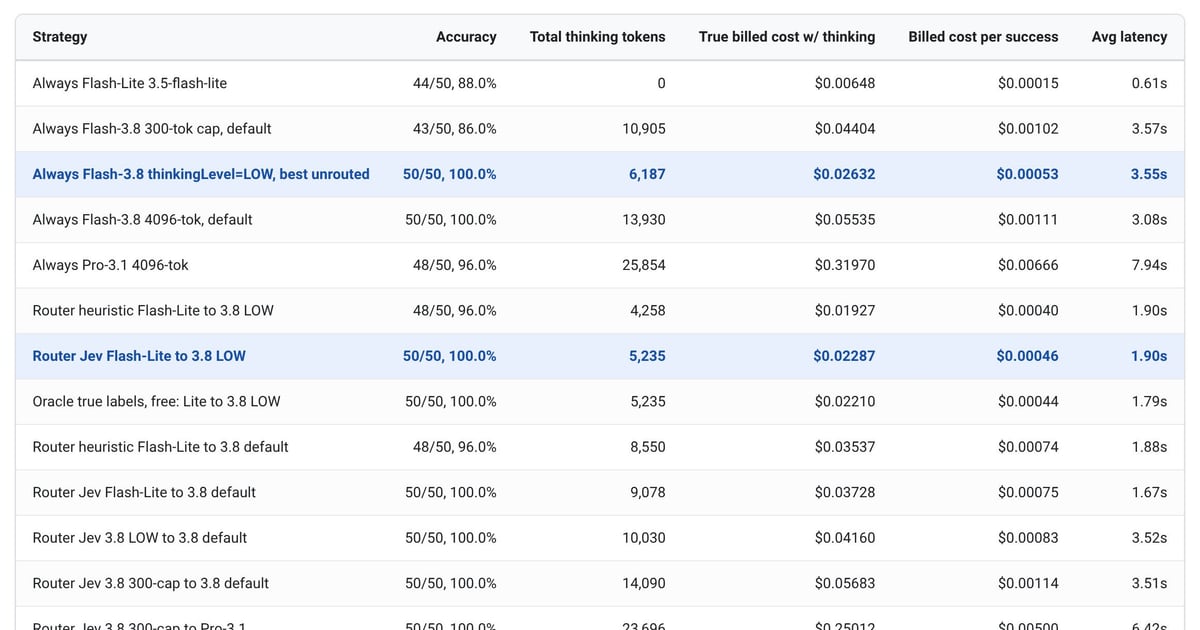
The experiment used 50 automatically graded questions. Google reports that both a low-thinking Gemini baseline and a routing approach using TypeSafe's Jev classifier answered all 50 correctly. In that test, routing offered a cost and response-time advantage over the low-thinking baseline. Google explicitly says the example is not an endorsement of TypeSafe.
These findings have narrow limits. The article describes one run per configuration, a small prompt set and hand-assigned difficulty. It also warns that switching models can complicate context caching. A result on short, standalone questions should not be read as a guaranteed saving for a long-running production agent.
JetherVerse's assessment is that an agency considering routing should begin with a representative workload and a clear definition of success. For customer support, that could include factual correctness and appropriate escalation. For coding work, it could include whether the proposed change passes relevant checks and satisfies the original requirement.
Our suggested pilot would keep the existing system as a baseline and test a routing candidate against the same examples. Record total cost, completion quality, waiting time and the amount of human correction needed. A cheaper response that creates additional review work may offer little practical value to a small team.
We also recommend treating a routing decision as a component that needs review. Keep examples of tasks that were assigned poorly, including the resulting mistakes, and use them to decide whether routing adds enough value to justify its complexity. The useful question for a business is whether the overall workflow becomes more dependable and economical. A favourable demonstration is a reason to test that possibility, rather than a substitute for testing it on the work the business actually performs.
Source:Google Developers Blog