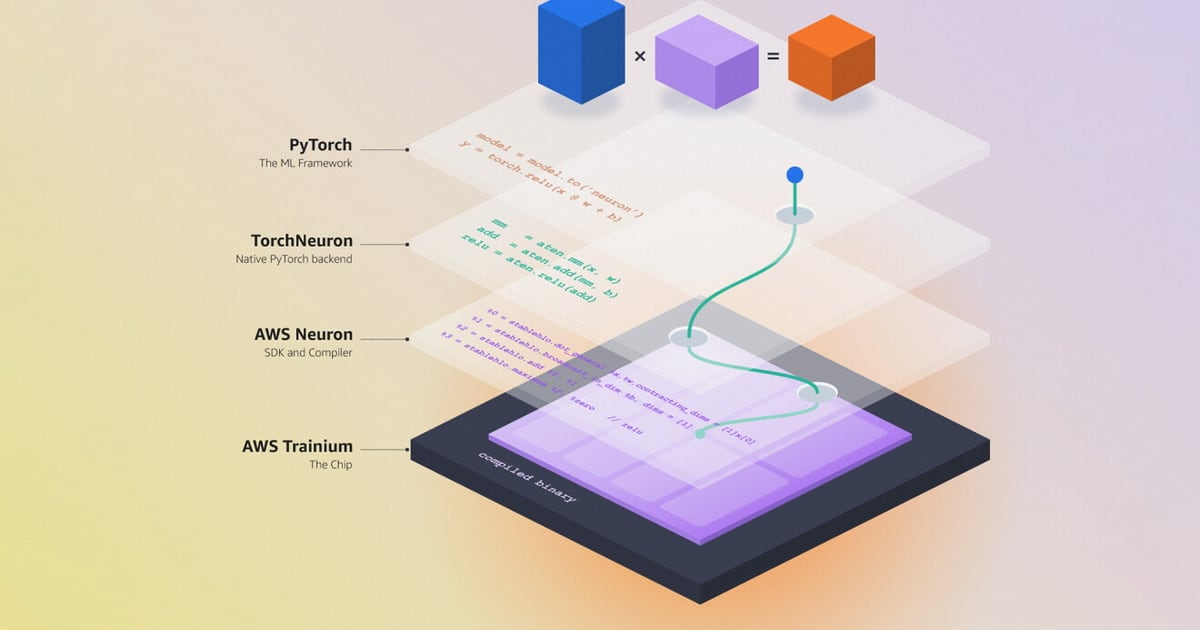
Amazon Brings Native PyTorch Support to Trainium With TorchNeuron
October 20, 2026
Read Original: Amazon and PyTorchAmazon has introduced TorchNeuron, a native backend that connects the PyTorch machine-learning framework to AWS Trainium chips. PyTorch's announcement schedules the public beta for October 20, while Amazon says the software will be released under the Apache 2.0 open-source licence.
The central promise is a simpler move between AI hardware platforms. Amazon says existing PyTorch code can run on Trainium with a configuration change rather than a substantial rewrite. TorchNeuron supports Trainium2 and Trainium3, according to the company.
PyTorch's announcement says developers will be able to install the beta through the AWS Neuron package repository. It also identifies a public GitHub repository and supporting documentation as resources scheduled to go live on October 20. Teams should check those release resources before treating the software as generally available.
Amazon describes early work spanning voice applications, robotics and scientific research. It also points to integration with familiar PyTorch tools and distributed training workflows. Those are vendor-reported capabilities, rather than an independent finding that every workload will migrate without difficulty.
The business significance is the prospect of spending less engineering time on infrastructure changes. For a small AI company, a cheaper processor is only useful if adapting the application does not consume the savings. A more familiar software environment could make a limited comparison easier to justify.
JetherVerse's practical takeaway is to evaluate this with a representative workload before changing production infrastructure. Run the same task on the existing environment and the candidate platform, check output quality, and compare the total bill alongside latency and operational effort.
A useful pilot should include failure recovery, monitoring and the developer time needed to maintain the deployment. It should also account for data movement and the work required to return to the previous setup if the experiment disappoints.
TorchNeuron broadens the options developers can investigate. It does not, by itself, establish that switching chips will improve every application's performance or reduce every company's costs.
For teams evaluating deployment options, JetherVerse's technical support service covers the operational side of keeping systems dependable: https://jetherverse.com/services/technical-support
Source:Amazon and PyTorch